


Gospel Partner: Daily Bible
JosephPrince.com
I usually approach devotional apps with a little caution. Many of them look useful at first, then turn into a collection of reminders, inspirational graphics, and unfinished notes that I stop opening after a week. Gospel Partner: Daily Bible feels more focused than that. It is a free Books & Reference app from JosephPrince.com built around a daily devotional routine, prayer, and journaling. In my experience, its value comes less from trying to replace every Bible tool and more from giving a Christian reader a clear place to begin the day.
The app has a 4.9 average from around 3.9 thousand ratings, and it has passed the 100 thousand install mark. Those figures suggest that the format connects with a substantial audience, but they do not tell me whether it will fit every reader. The important question is how it works in ordinary life: when I have a few quiet minutes, what does the app help me do, and what happens after I finish reading?
From a distracted morning to a repeatable devotional routine
My starting condition is familiar: I want to read something meaningful before work, but I do not necessarily have the time or attention for a long study session. Opening a large Bible app can lead me into searches, cross-references, reading plans, and notifications. Those tools are valuable, but they can also create too many decisions. Gospel Partner: Daily Bible takes a narrower route by placing the daily devotional experience at the center.
I found that useful on mornings when I needed structure rather than a blank page. Instead of asking myself which passage to choose or what topic to investigate, I could begin with the material presented for the day. That makes the first handoff simple: the app takes me from a general intention to a specific reading. For someone trying to establish a habit, reducing that first decision can matter more than having an enormous library of options.
The store summary describes the experience as “Daily Devo, Prayer & Journal,” while the short description calls it “Gospel Partner.” I read those phrases as a practical outline rather than a promise of a complete study suite. The app is designed to connect three actions: receive a devotional thought, respond in prayer, and leave a personal record. That sequence gives the session a beginning, middle, and end.
Related News

Why WhatsApp Messenger Still Makes Everyday Communication Feel Easy

Jurassic World: The Game Is the Better Dino Tycoon for Strategic Players

Threads in Real Life: Who Should Join, Lurk, or Leave

How SHEIN Turned Shopping Into an Endless Content Feed

How to Make Fortnite Feel Smarter on Mobile

Should You Switch to Microsoft Outlook on Mobile?
The first step is the devotional reading itself. I recommend treating it as a starting point, not as a substitute for reading the surrounding Bible passage. A short devotional can help me focus on a theme, but context still matters. When a thought raises a question, I prefer to pause and open a separate Bible resource for the wider passage. This is one of the app’s central trade-offs: it is convenient for guided reflection, while a dedicated Bible app is usually better for detailed navigation and comparison.
After reading, the prayer stage changes the pace. Rather than closing the app as soon as I reach the end of the text, I can use the moment to turn the idea into a personal response. I find this especially helpful when the devotional touches a concern I have been carrying through the day. The transition from reading to prayer is not dramatic, but it prevents the session from becoming passive scrolling.
The journal step is where the routine becomes more personal. I do not try to write a polished entry. A few honest lines work better: what stood out, what I am worried about, or what I want to remember later. This is one of the less obvious strengths of the format. The journal is not only a place to collect impressive thoughts; it can act as a handoff from the app’s message to my own memory and decisions.
Gallery
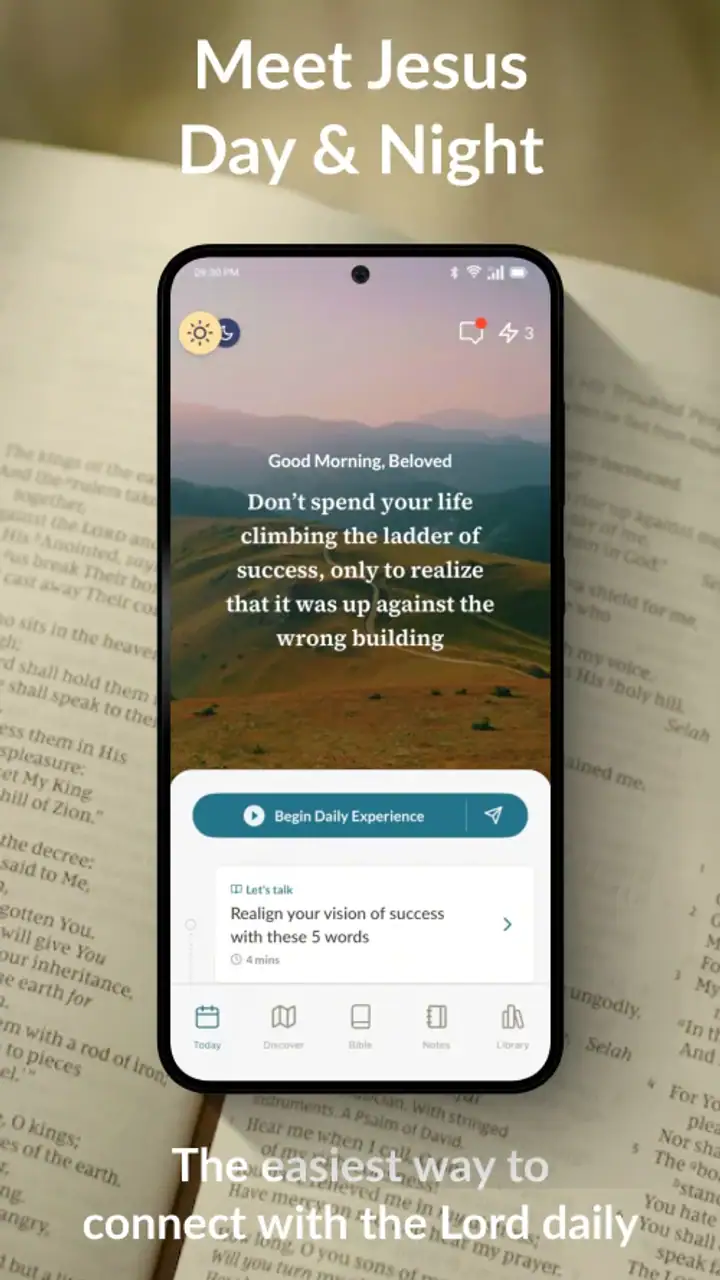
For a realistic example, imagine opening the app on a weekday morning while breakfast is being prepared. I read the daily material, note one sentence that applies to a difficult conversation at work, and write a brief prayer about responding calmly. Later, the journal entry gives me something concrete to revisit. The outcome is not that the app solved the conversation. It helped me turn a vague intention into a small, repeatable action.
How I use the reading, prayer, and journal stages together
I get more from the app when I keep the three stages connected. Reading alone can be encouraging but easy to forget. Journaling without reflection can become a private list of worries. Prayer without a clear focus can feel rushed. Using the devotional as the input, prayer as the response, and the journal as the record creates a simple workflow that is easier to repeat.
My practical tip is to write one specific sentence rather than trying to document the entire session. For example, I might record the person I need to forgive, the habit I want to change, or the decision I need wisdom about. That makes the journal useful when I return to it. It also prevents the app from becoming another task that demands too much time.
A second useful approach is to separate “reading time” from “study time.” If I want to compare translations, trace a theme through several passages, or look up a word, I move to a fuller Bible reference tool afterward. Gospel Partner: Daily Bible works best as the first step in that process. It gives me a devotional lens, while another resource can handle the research.
A third tip is to use the journal as a bridge into the rest of the day. Before closing the app, I can identify one behavior connected to the reading. That might mean sending an encouraging message, making time for prayer later, or approaching a problem with more patience. This turns the session into a handoff toward real life instead of leaving the thought inside the app.
Where the handoffs are smooth and where they need effort
The smoothest handoff is from the devotional to prayer. The app’s purpose is clear, so I do not need to invent a complicated routine. The next handoff, from prayer to journaling, depends more on my discipline. If I am in a hurry, it is easy to close the app and tell myself I will write later. In practice, later often means never. Keeping the entry short makes that failure less likely.
The handoff from the app to a broader Bible study is less seamless because the app is not the only tool I use for that job. When I want deep reference features, I need to leave the devotional flow and open something else. I do not consider that a serious flaw; it is a reminder that this app has a defined role. People looking for one application that combines extensive Bible navigation, scholarly resources, note systems, and devotional content may prefer a more comprehensive alternative.
There is also a personal handoff that matters: moving from the app’s devotional voice to my own judgment. I do not accept every short reflection as the end of a question. I check the biblical context and consider how the message applies to my situation. That habit keeps the app useful without making it the sole authority in my study routine.
The app is free to install, which makes trying the basic experience straightforward. It also includes in-app purchases ranging from around seven dollars to around fifty-five dollars per item. I would pay attention to the purchase screens before committing to anything. A free entry point is helpful, but readers should understand which parts of their preferred routine may involve additional spending and whether that fits their expectations.
For families, the Everyone content rating makes the app approachable as a general devotional resource. Still, an age rating does not mean that every child will engage with it independently. Younger readers may need help understanding the devotional language, connecting it with the Bible passage, and using the journal thoughtfully. I see it primarily as a personal or family-supported tool rather than an automatic substitute for conversation.
What the finished routine gives me
The result I notice is consistency rather than novelty. Gospel Partner: Daily Bible does not need to surprise me with a new productivity system every morning. Its strength is that it gives a familiar path: open the daily material, reflect, pray, and record something. When I repeat that path, I have a better chance of remembering what I read and noticing how it connects with my decisions.
The journal also changes the way I measure progress. I am not only counting how many days I opened the app. I can look back at recurring concerns, answered prayers, or themes I keep encountering. That makes the experience more reflective than a simple streak. The value grows when I use the record to notice patterns in my spiritual life rather than treating it as another score.
I would recommend it to someone who wants a guided daily devotional connected to prayer and personal notes, especially if a full-featured Bible app feels overwhelming. It is also a reasonable choice for a reader who already has a Bible app but wants a more intentional beginning to the day. The developer, JosephPrince.com, has kept the app’s identity closely tied to this devotional pathway rather than presenting it as an all-purpose reference shelf.
It is less suitable for someone whose main goal is intensive Bible study. If your priority is rapidly locating passages, comparing translations, following a detailed reading plan, or building extensive cross-referenced notes, a dedicated Bible study application will probably serve you better. I would also skip it if I wanted a completely neutral reading environment without a particular devotional voice. The app’s guided character is part of its appeal, but it will not match every theological or personal preference.
Another limitation is the risk of routine fatigue. A daily format can become mechanical if I rush through it simply to say I completed it. The solution is not to force longer sessions. I get better results by slowing down for one meaningful sentence, writing a concrete prayer, and returning to the journal when the day presents a related situation. The app supports that habit, but it cannot create attention or sincerity on my behalf.
Device compatibility is also worth checking before installation. The current version is 5.4.6 and requires Android 7.0 or later. That covers many devices, but anyone using an older Android phone should confirm compatibility first. The app is available as an Android experience, so iPhone users should look for the appropriate iOS availability before planning their routine around it.
My judgment after following the complete workflow
After using Gospel Partner: Daily Bible as a complete process rather than merely opening its daily reading, I see its strongest idea clearly: a devotional should lead somewhere. The reading supplies a focus, prayer makes it personal, and journaling leaves a trace that can influence the rest of the day. That input-to-outcome flow is simple, but it is more useful than a collection of disconnected inspirational pages.
The app is at its best when you want a guided starting point, not an entire library of study tools. I would use it in the morning, during a quiet lunch break, or in the evening when I need to turn a thought into a prayer. I would pair it with a fuller Bible reference app when questions require context, and I would keep journal entries brief enough that the routine remains realistic.
Its strong user response, with a 4.9 average and around 3.9 thousand ratings, supports the impression that the approach works for many readers. Even so, I would not choose an app based on ratings alone. The real test is whether its devotional voice, purchase structure, and focused workflow suit the way you already read and pray.
For me, the final outcome is a modest but worthwhile improvement: I am less likely to open my phone with a vague intention and more likely to finish with a clear thought, a personal prayer, and one practical response. That is enough reason to try this free daily Bible devotional app if you want structure. Just keep its role in perspective, use another tool when you need deeper reference work, and let the journal serve your life rather than becoming another box to tick.
Gospel Partner: Daily Bible is therefore a good fit for readers who value guided reflection and a simple devotional rhythm. It is not the right choice for everyone, but when the reading-to-prayer-to-journal handoff matches your needs, it offers a focused way to make a few minutes of quiet time more deliberate.
FAQs for Gospel Partner: Daily Bible
What is Gospel Partner: Daily Bible, and what can I use it for?
Gospel Partner: Daily Bible is a Christian devotional and Bible-focused app designed to support daily spiritual growth. After exploring its main features, I found it useful for reading Scripture, following devotional content, reflecting on biblical messages, and maintaining a consistent faith routine. It is aimed at users who want convenient access to Christian encouragement and Bible-based material on an Android or iOS device.
Does Gospel Partner: Daily Bible require an internet connection?
An internet connection is generally needed to download the app, load updated devotional content, stream media, and access certain online features. Some Bible passages or previously loaded materials may remain available depending on the app version and device settings, but users should not assume that every feature works offline. If you plan to use it while traveling, open the content beforehand and check what remains accessible without mobile data or Wi-Fi.
Is Gospel Partner: Daily Bible free to download and use?
The app may be available as a free download, although some content, services, or optional features can depend on the current version and regional availability. Before downloading, check the official Google Play Store or Apple App Store listing for subscription details, in-app purchases, and any limitations. Reviewing the payment terms is especially important if the app offers premium devotional material or recurring access.
Can beginners use Gospel Partner: Daily Bible, or is it intended for experienced Bible readers?
Beginners can use Gospel Partner: Daily Bible without extensive knowledge of Scripture. Its devotional approach and organized content can make it easier to start a daily reading habit, while more experienced readers may appreciate having Bible-based encouragement in one place. However, the depth and structure of the experience can vary by available content, so users seeking advanced study tools, original-language resources, or detailed commentary may need additional applications.
What should I consider before downloading Gospel Partner: Daily Bible?
Before downloading, consider whether the app’s devotional style, Bible content, language options, and media features match your personal preferences and denomination. You should also review its privacy policy, permissions, storage requirements, update history, and any subscription conditions. The app can be valuable for daily encouragement, but it should complement—not replace—personal Bible study, prayer, and guidance from trusted Christian teachers or your local church.
Pros
- Daily Bible content is easy to access for quick devotional moments.
- Simple navigation makes it suitable for users of different ages.
- Helpful reminders can encourage a more consistent reading routine.
- Faith-focused content offers encouragement during stressful days.
- The app is convenient for reading Scripture while traveling or offline.
Cons
- Some content may require an internet connection to load properly.
- Limited customization may disappoint users wanting more reading controls.
- Notifications can feel repetitive if enabled too frequently.
- The devotional approach may not suit users seeking detailed Bible study tools.
- Content availability and features may vary by language or region.


